agent-skills-platform
Governed Team Skill Marketplace — Complete Timeline
Use this page from top to bottom. It contains every command needed to create an ACME marketplace, admit individual skills, release approved bundles, install them in VS Code Copilot Agent Mode, and update or roll them back.
Choose the Git provider first
| ACME environment | Use |
|---|---|
| GitHub plus VS Code Copilot Agent Mode | Use the default github backend below. |
| GitLab.com | Add --provider gitlab; use the GitLab command timeline. |
| Self-managed GitLab | Add --provider gitlab --host <hostname>; nested groups are supported. |
Both backends use the same schema-v2 bundles, quality gates, catalog, approval
evidence, CODEOWNERS, and immutable version pins. GitHub generates Actions and uses
gh skill; GitLab generates .gitlab-ci.yml, releases with glab, and installs
from a shallow clone at the exact tag.
ONE-TIME SETUP                         REPEATED FOR EACH CHANGE

Prerequisites → Initialize → Protect   READY interview → Create → Add → Review → Release
                                                                      ↓
Correction ← Use ← Pinned install ← Approved semantic-version tag
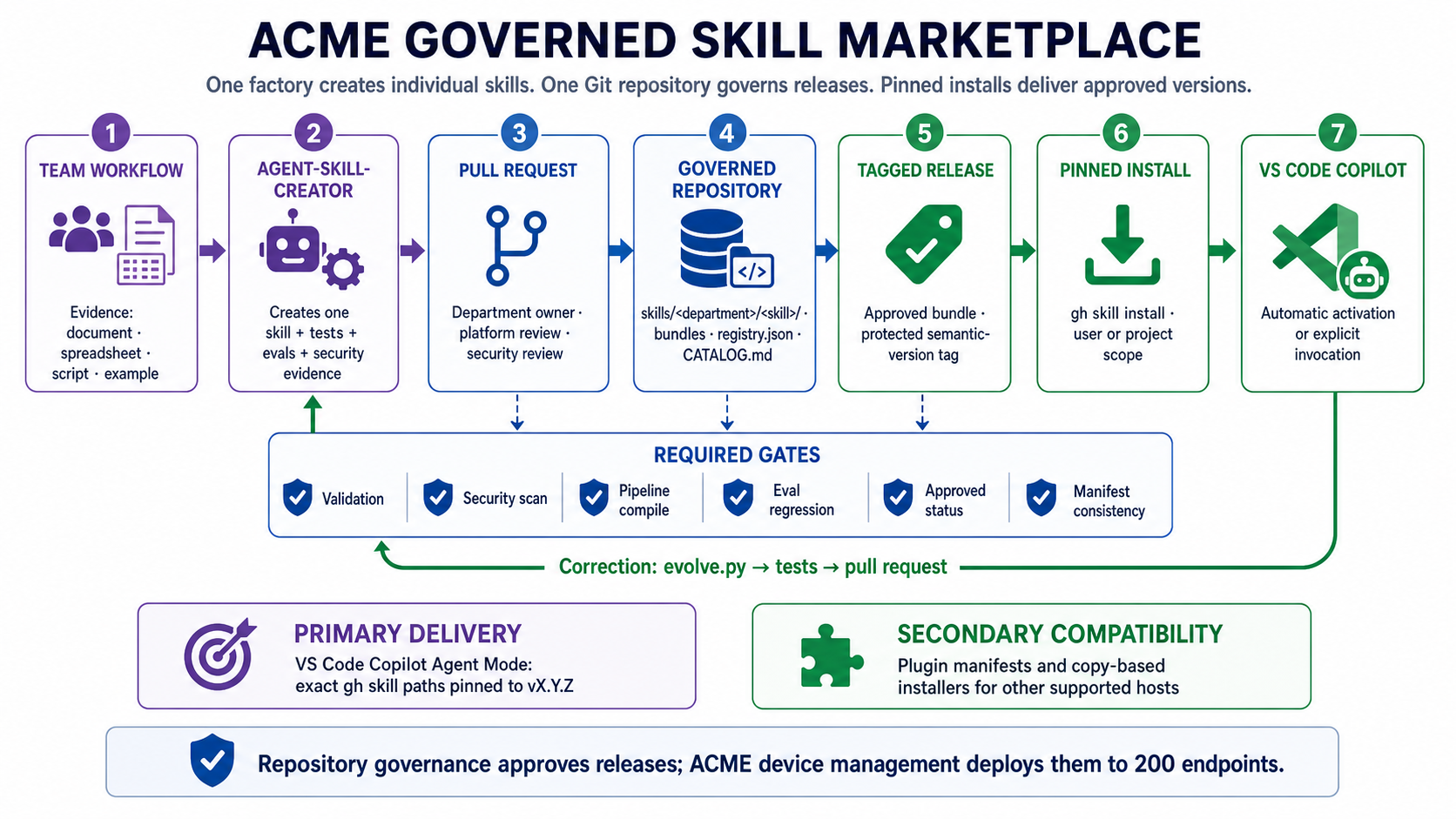
Governance begins before generation
Marketplace governance starts with a resumable interview.json, not when a completed
skill is submitted. The agent inspects workflow evidence, records its conclusions as
proposed, and preserves supported disagreements as conflicting. An identified
human owner must confirm consequential meaning and risk before the interview becomes
READY; missing evidence or authority leaves it BLOCKED and resumable.
Only a READY interview permits skill generation. The generated skill preserves that
file as its evidence-and-authority trail, and marketplace validation rejects a present
but unresolved interview. The marketplace operator reviews the authorized contract
and its implementation; the operator does not silently supply missing business
authority. See the structured interview protocol.
Roles and handoffs
This marketplace has two distinct users. Do not send the command-line sections below to a subject-matter expert unless they are also the marketplace operator.
| Role | Does | Does not do | Handoff |
|---|---|---|---|
| Workflow expert / SME | Describes the work in plain language; supplies real artifacts; confirms business meaning, risk, and a representative result | Use Git, edit the registry, run marketplace CLI commands, select release tags, or manage endpoint policy | “This skill is correct; publish it to <department>.” |
| Marketplace operator / platform team | Runs admission, governance, release, deployment, update, quarantine, and rollback | Invent missing business authority or approve unresolved meanings for the SME | Publishes a governed, exact version for users to install |
| Skill consumer | Installs or receives the approved skill and uses it in their agent | Edit an installed copy or bypass its pinned release | Reports corrections to the SME/owner |
The SME’s starting prompt can be as small as:
Turn my monthly revenue-variance review into a reusable internal skill.
I attached the past reports and source spreadsheets. The decision is whether to
escalate a material variance. It must not modify source data.
The skill factory turns that evidence into a tested artifact. Only after the SME approves the representative result does the operator begin the command-line workflow in Phase A and beyond.
What each component does
| Component | Responsibility |
|---|---|
agent-skills-platform |
Creates and verifies one individual skill from workflow evidence. |
| Governed Git repository | Catalogs skills by department, runs gates, records approval, and builds bundles. |
| Provider backend | Uses gh skill on GitHub or tagged Git clone and copy on GitLab. |
| ACME device management | Runs the managed install command on approved endpoints. |
Plugins are a secondary compatibility channel for supported CLI hosts. For VS Code Copilot Agent Mode, use the provider’s pinned bundle install operation.
Phase A — One-time platform setup
A1. Confirm prerequisites
Run these commands on the platform developer’s machine:
python3 --version
gh --version
gh auth status
gh skill --help
Required state:
- Python 3.10 or newer.
- Authenticated GitHub CLI 2.90 or newer.
gh skillavailable. It remains a public-preview command.- Permission to create and protect the target GitHub repository.
A2. Initialize the marketplace
Run from the agent-skills-platform repository:
python3 scripts/team_marketplace.py init \
  --name "ACME Skills" \
  --repository ACME/acme-skills \
  --department finance=finance-owner \
  --department operations=operations-owner \
  --approver acme-platform \
  --approver acme-security \
  --supported-platform github-copilot \
  --starter-bundle analyst-starter \
  --marketplace ./acme-skills
Repeat --department SLUG=OWNER, --approver, --supported-platform, and
--starter-bundle as needed. The generated registry, CODEOWNERS, governance policy,
and empty bundle manifests carry these declarations; no manual registry edit is
required.
This creates:
acme-skills/
├── skills/<department>/<skill>/
├── bundles/
├── scripts/team_marketplace.py
├── registry.json
├── CATALOG.md
├── CODEOWNERS
├── GOVERNANCE.md
└── .github/workflows/
To migrate an existing schema-v1 registry, initialize with one additional option:
python3 scripts/team_marketplace.py init \
  --name "ACME Skills" \
  --repository ACME/acme-skills \
  --from-registry ./legacy-registry \
  --marketplace ./acme-skills
Migration never grants approval. Migrated skills remain draft until their source,
owners, scripts, and quality evidence are reviewed.
A starter bundle created with --starter-bundle may be empty before the first
admission. Its generated manifest is:
{
  "name": "analyst-starter",
  "skills": []
}
Do not add a placeholder or nonexistent skill to populate it.
A3. Put the scaffold in GitHub
cd ./acme-skills
git init
git add -A
git commit -m "feat: initialize governed ACME skill marketplace"
gh repo create ACME/acme-skills --private --source=. --push
Do not add individual skills before the repository governance is configured.
A4. Protect releases and reviews
Open GOVERNANCE.md in the generated repository. Configure the GitHub default
branch ruleset to require:
- Pull requests and CODEOWNER review.
- The
governed-marketplacestatus check. - Department-owner plus platform/security approval.
- No force pushes or branch deletion.
Configure a tag ruleset for v*.*.* that restricts tag creation, updates, and
deletion to release administrators. GitHub settings are required here; there is no
local command that can prove the organization applied its rulesets correctly.
Phase B — Repeat for each individual skill
B1. Create and verify one skill
In an installed agent environment, provide the real workflow evidence:
/agent-skills-platform Create a skill from the attached ACME monthly reporting workflow.
Every skill is checked as one connected system. The skill graph links its instructions, scripts, evaluations, and expected outputs. Two structural requirements confirm that every expected result is tested and every predictable multi-step workflow has one reliable entry point. Four checks—specification, pipeline, security, and evaluation schema—run in parallel. Finally, a representative run proves that the skill produces a useful result.
A skill is ready for marketplace intake only after both structural requirements, all four checks, and the representative run pass.
Before add, its SKILL.md metadata must include real values:
metadata:
  author: ACME Finance
  version: 1.2.0
  approval_status: approved
  owners: [acme-finance-skills]
Do not declare allowed-tools: shell or allowed-tools: bash. Copilot must request
runtime permission when a reviewed script actually needs execution.
B2. Add the skill to a department and bundle
Run from the agent-skills-platform repository, pointing at the marketplace clone:
python3 scripts/team_marketplace.py add ./report-skill \
  --department finance \
  --bundle analyst-starter \
  --marketplace ./acme-skills
add runs the gates before copying. A failure stops intake. A successful add writes
the skill to skills/finance/report-skill/, updates registry.json, regenerates the
bundle manifest and catalog, and updates CODEOWNERS.
B3. Run the repository check
python3 scripts/team_marketplace.py check \
  --marketplace ./acme-skills
The check refuses draft skills, failed gates, duplicate identities, missing owners, unsafe tool pre-approval, path traversal, inconsistent metadata, and broken bundle manifests.
B4. Submit the governed change
cd ./acme-skills
git switch -c feat/add-finance-report-skill
git add -A
git commit -m "feat: add ACME finance report skill"
git push -u origin feat/add-finance-report-skill
gh pr create --fill
Department, platform, and security owners review the pull request. Merge only after the generated GitHub Actions checks and required reviews pass.
Phase C — Release and deliver approved bundles
C1. Release an immutable version
Before the release pull request merges, record the reviewed release authorization:
python3 scripts/team_marketplace.py lifecycle report-skill \
  --department finance --to published --marketplace .
Commit that generated registry and catalog change through the normal review path. After the pull request reaches the protected default branch:
git switch main
git pull --ff-only
python3 scripts/team_marketplace.py release \
  --tag v1.2.0 \
  --marketplace .
release reruns marketplace checks, requires a semantic-version tag, and calls
gh skill publish. Do not reuse or move an existing release tag.
C2. Install the approved bundle
User scope makes the bundle available across the analyst’s projects:
python3 scripts/team_marketplace.py install \
  --bundle analyst-starter \
  --scope user \
  --pin v1.2.0 \
  --marketplace ./acme-skills
Project scope installs it only for the current repository:
python3 scripts/team_marketplace.py install \
  --bundle analyst-starter \
  --scope project \
  --pin v1.2.0 \
  --marketplace ./acme-skills
Install one discovered skill without pulling its whole bundle:
python3 scripts/team_marketplace.py install \
  --skill report-skill \
  --department finance \
  --scope project \
  --pin v1.2.0 \
  --marketplace ./acme-skills
Single-skill installs use the same lifecycle checks, immutable version pinning, provider adapter, and privacy-safe install event as bundle installs.
The wrapper issues one exact command per bundled skill:
gh skill install ACME/acme-skills skills/finance/report-skill \
  --agent github-copilot \
  --scope user \
  --pin v1.2.0
The marketplace controls what may be installed. ACME endpoint management controls how that command reaches 200 managed devices.
C3. Update or roll back
Update by explicitly installing a newer approved release:
python3 scripts/team_marketplace.py install \
  --bundle analyst-starter \
  --scope user \
  --pin v1.3.0 \
  --force \
  --marketplace ./acme-skills
Roll back by reinstalling the last known-good tag:
python3 scripts/team_marketplace.py install \
  --bundle analyst-starter \
  --scope user \
  --pin v1.2.0 \
  --force \
  --marketplace ./acme-skills
There is no moving “latest” channel in the governed workflow. Every managed change names the exact release that should be present.
For a local provider test, clone or check out the exact immutable tag into a temporary source directory, then run the project-scoped install from the clean consumer project. Installing from the marketplace’s mutable working tree does not prove release or rollback behavior.
git -C /tmp/acme-skills checkout --detach v1.2.0
cd /tmp/clean-consumer-project
python3 /tmp/acme-skills/scripts/team_marketplace.py install \
  --bundle analyst-starter \
  --scope project \
  --local \
  --pin v1.2.0 \
  --marketplace /tmp/acme-skills
With --local --pin, the CLI verifies that marketplace HEAD is the exact requested
tag before invoking the provider’s local transport. It does not pass an incompatible
pin argument through to gh skill --from-local.
C4. Correct a skill through the repository
Never edit an installed copy. Capture the correction in the skill source:
python3 ./report-skill/scripts/evolve.py \
  --correct "ACME UK revenue closes one business day later"
Commit and attest the corrected source, then update the existing marketplace entry:
python3 scripts/team_marketplace.py update ./report-skill \
  --department finance --marketplace ./acme-skills
update requires a strictly newer semantic version and reruns validation, security,
pipeline, eval, clean-commit, and representative-run attestation gates before it
replaces any files. It preserves bundle membership, resets lifecycle to approved,
and clears compatibility certification because evidence from an older version cannot
certify the new payload. Open a pull request, obtain approval, re-certify supported
platforms, transition to published, release a new semantic-version tag, and install
the new pin.
Command map
| When | Command | Result |
|---|---|---|
| Once | team_marketplace.py init |
Creates the governed repository scaffold. |
| Every intake | team_marketplace.py add |
Gates and copies one skill into a department and bundle. |
| Every new version | team_marketplace.py update |
Re-gates a strictly newer version and preserves its bundles. |
| After intake, per version | team_marketplace.py reliability |
Runs the skill inside each installed agent runtime and certifies what passes. |
| Before PR/release | team_marketplace.py check |
Verifies the complete marketplace state. |
| After approved merge | team_marketplace.py release --tag vX.Y.Z |
Publishes an immutable approved release. |
| Deployment/update/rollback | team_marketplace.py install --pin vX.Y.Z |
Installs exact bundled skills for Copilot. |
Trust evidence and lifecycle
Marketplace intake now requires executable evals and a representative-run attestation bound to the exact, clean Git commit being submitted. After committing the skill, create the evidence:
python3 scripts/team_marketplace.py attest ./report-skill \
  --run-id representative-2026-08-25 \
  --completed-at 2026-08-25T15:00:00Z
The skill lifecycle is draft → in-review → approved → published. Incident and
retirement paths add quarantined, deprecated, and retired. Only an authorized
transition is accepted:
python3 scripts/team_marketplace.py lifecycle report-skill \
  --department finance --to quarantined --marketplace ./acme-skills
Quarantined, deprecated, and retired skills cannot be installed. The
approved → published transition is committed before release so GitHub and GitLab
publish the exact reviewed registry state.
When repair would preserve the wrong assumptions, retire and recreate the skill as a
new generation. Recreation resets the skill version to 1.0.0, assigns a fresh
lineage identity, records the reset reason and predecessor, and does not inherit
attestations, eval baselines, compatibility certifications, or success metrics. It
preserves governed history; erasing sensitive material from Git history, tags,
releases, caches, and artifacts is a separate privileged purge procedure.
python3 scripts/team_marketplace.py recreate ./replacement-skill \
  --department finance \
  --reason "The original decision model is no longer valid" \
  --marketplace ./acme-skills
The existing identity must already be retired, and the replacement source version
must be exactly 1.0.0. recreate reruns every fresh admission and attestation gate,
preserves bundle membership, creates an approved next generation with a new
lineage_id, clears certifications, and retains a predecessor/reason tombstone.
Blind cross-team acceptance
Technical checks do not prove that another department can operate the marketplace. Run the blind organizational acceptance protocol with isolated administrator, workflow-expert, operator, and consumer sessions. The exact gate is create, publish, discover, install, invoke twice, update, rollback, quarantine, blocked install, retire, and recreate. Any undocumented assistance or implementation inspection before a recorded failure makes the run fail.
Maintenance health control plane
GitHub marketplaces include a weekly marketplace-health workflow. GitLab includes
the equivalent scheduled-pipeline job. The report covers skill review, semantic
freshness, dependencies, eval regressions, active owners, and compatibility. Run the
same six checks locally:
python3 scripts/team_marketplace.py health --marketplace ./acme-skills \
  --output MARKETPLACE_HEALTH.md --json-output marketplace-health.json
An overdue human-owned semantic definition is critical health evidence and blocks a release until its owner reviews the meaning and updates the contract date or version.
Migrating existing skills
Skills created before semantic contracts remain installable. Validation treats a
missing field as {"applies": false} and emits a migration warning. Before the next
release, add one of these to discovery.json:
{"semantic_contract": {"applies": false}}
Use a complete contract instead when the answer depends on organizational definitions, scope, grain, units, time interpretation, or source precedence. The domain owner—not the agent or marketplace operator—approves that meaning.
Environment, risk, and portfolio gates
Marketplace intake rejects skills unless discovery.json contains:
- documentation and data sources the skill must understand;
- required capabilities and blocking readiness checks;
- a risk tier, complete permission disclosure, and mutation boundary;
- an explicit semantic contract applicability decision for newly generated skills; and
- at least three queries that should trigger and three that should not trigger.
Installation is not readiness. plan-install includes the exact environment and risk
preflight that must pass in the consumer environment before useful execution.
Before release, run portfolio routing and coexistence checks:
python3 scripts/team_marketplace.py portfolio-check \
  --marketplace ./acme-skills
The check fails when a positive query routes to the wrong skill, a negative query routes back to the prohibited skill, or the top two candidates tie. Release-mode marketplace checks enforce the same gate.
Guided organizational onboarding
Generate a department readiness report after marketplace initialization:
python3 scripts/team_marketplace.py onboarding-report \
  --marketplace ./acme-skills
The report blocks readiness until the marketplace has at least two departments, named owners, an independent approver, a supported platform, and a starter bundle. It then shows each department’s owned and published skill counts and names the next acceptance gate.
The report covers review staleness, dependency evidence, eval regressions, active
owners, and current-version compatibility certification. Critical findings make the
command fail so scheduled automation can alert maintainers.

## Outcome-based discovery

Add `discovery.json` to each skill. The required decision contract names the
`question`, observable `trigger` conditions, supported `decision` choices, required
`evidence`, and `success_measure`. Also include the outcome, intended users, input
and output types, use cases, examples, permissions/systems, completion time,
compatibility claims, and support tier (`supported`, `community`, or `deprecated`).
Intake rejects missing or empty decision fields and generates one structured page
under `skill-pages/`.

```bash
python3 scripts/team_marketplace.py search "monthly revenue review" \
  --platform codex --support-tier supported --marketplace ./acme-skills
Search ranks outcome matches first and returns only published skills. Platform
filters require current-version certification rather than an unverified claim.
Generic instruction words are ignored, weak one-token overlaps are not returned,
and substantial matches to a skill’s should_not_trigger examples exclude it.
Consented product measurement
Organizational metrics are off by default. Enable the closed, privacy-safe event vocabulary with an expiring consent artifact:
python3 scripts/team_marketplace.py metrics-consent \
  --expires-at 2027-08-25T00:00:00Z --marketplace ./acme-skills
The local ledger records only salted skill IDs, event type, UTC time, success, optional duration, and an allowlisted platform. It stores no prompts, inputs, outputs, paths, people, or organization identifiers. Record activation and use from approved runtime automation, then inspect aggregates:
python3 scripts/team_marketplace.py metrics-record activation \
  --skill report-skill --platform codex --marketplace ./acme-skills
python3 scripts/team_marketplace.py metrics-summary --marketplace ./acme-skills
Distribution plans and compatibility certification
Runtime capability resolution (design contract)
Managed installation remains the supported distribution path. For organizations that need a policy-resolved runtime catalog, use the proposed Capability Resolver Contract. It preserves immutable release pins, compatibility certification, quarantine, and auditability; it does not make an unreviewed “latest” skill silently executable.
Resolve the exact published and platform-certified artifacts visible in a local schema-v2 marketplace without writing to it. Resolution is deny-by-default, so first apply at least one allow policy:
[
  {
    "id": "finance-codex-managed",
    "effect": "allow",
    "subjects": ["group:finance-analysts"],
    "agents": ["codex-cli"],
    "projects": ["github:acme/quarterly-close"],
    "environments": ["managed-macos"],
    "platforms": ["codex"],
    "skills": ["finance/report-skill"]
  }
]
python3 scripts/team_marketplace.py policy.apply \
  --file ./resolver-policies.json --marketplace ./acme-skills
Then resolve:
export SKILL_RESOLVER_ATTESTATION_SECRET='set-only-in-the-resolver-service'
python3 scripts/team_marketplace.py skills.resolve \
  --attestation ./signed-execution-attestation.json \
  --skill finance/report-skill \
  --marketplace ./acme-skills
The signed attestation must include an issuer, marketplace audience, a maximum
five-minute validity window, nonce, identity claims, and a managed device ID. Its
HMAC-SHA-256 signature is verified using SKILL_RESOLVER_ATTESTATION_SECRET, which
belongs only in the resolver service or secret manager—not on user machines. The JSON
response includes the verified context, device ID, policy revision, marketplace commit,
exact skill version, relative artifact path, and deterministic SHA-256 directory hash.
Matching deny policies override allows.
Platform IDs are canonicalized across governance, planning, installation, search,
health, and certification. Use github-copilot; the legacy copilot input remains
accepted as an alias but stored evidence and generated plans always emit
github-copilot.
Generate a non-mutating plan before managed distribution. Remote plans require an immutable tag matching the skill version or a full commit SHA:
python3 scripts/team_marketplace.py plan-install report-skill \
  --department finance --platforms codex,cursor,github-copilot \
  --scope user --release-ref v1.2.3 --marketplace ./acme-skills
Certification evidence names the platform, skill version, adapter and adapter
version, plus unique explicit checks whose passed values are true. Persist verified
evidence with:
python3 scripts/team_marketplace.py certify report-skill \
  --department finance --platform codex --evidence codex-evidence.json \
  --marketplace ./acme-skills
The adapters use scripts/platforms.py as the canonical platform registry. Native
and adapted artifact plans therefore stay aligned with the factory installers.
check --release blocks every declared platform that lacks passing certification
for the exact skill version. Updating a skill clears older certification evidence,
so certification must be repeated before the next release.
Agent-run reliability evidence (Caliper)
Certification evidence is only as good as the checks behind it. For claude-code and
codex, the operator’s agent lets Caliper earn those checks: the skill is
installed in a fresh HOME, discovered from its description, followed rather than
improvised, and passes k times. One command measures every declared platform whose
agent CLI is installed on the operator’s machine and certifies what passes:
python3 scripts/team_marketplace.py reliability report-skill \
  --department finance --marketplace ./acme-skills
It runs the governed copy’s evals/caliper/<skill>.eval.yaml once per platform
(--k 3, --timeout 180, one attempt at a time, judged by the other vendor when both
CLIs are present), binds each run to the released SKILL.md hash and commit through
scripts/caliper_evidence.py, and calls certify for every platform that clears the
thresholds. The JSON report names each platform as certified, refused (with the
failing threshold), failed (Caliper did not produce a run), or skipped (no Caliper
backend, or its CLI is absent). GitHub Copilot and the other platforms keep the
representative-run attestation as their evidence. --no-certify measures without
writing; --platform limits the run; raw and pruned runs land under
<marketplace>/.caliper/runs/.
Stored records keep only check names, so each name states its threshold and the observed
value (caliper:success_rate>=0.90(observed=1.00)). To make agent-run evidence a release
condition, add --require-reliability to check --release: every claude-code or
codex certification must then carry caliper:* checks, so a hand-written evidence file
no longer certifies those platforms. Runs are local to the operator’s machine; CI
validates spec syntax only.